AI assistants
Milkloft and your AI assistant: prompts that make it show its sources
If you ask ChatGPT, Claude or Gemini how long your pumped milk lasts, you will usually get a confident number and no source, and sometimes a number no guideline publishes. The seven prompts below fix that: they make the assistant name the guideline behind every figure and say 'no published figure' when there is none. Below them, the five mistakes we see most often, and the open export that lets you take your own data anywhere.
In short
Every storage figure on this site traces to the CDC, ABM Protocol #8 or the NHS, and every date is an estimate.
Where assistants usually get milk storage wrong
These five are not exotic. They come up in ordinary questions, and each one has a guide here that shows the published wording instead of a number with no parent.
- Starting the thaw clock at the wrong moment. The CDC's 24 hours run from the moment the milk is fully thawed, not from when the bag left the freezer. An assistant that misses that is usually generous by a whole night. See the 24-hour thaw clock.
- Blending guidelines into one table. The CDC gives 4 days in the fridge; the NHS gives up to 8 days at 4 °C or lower, with a shorter window if the fridge is warmer or its temperature is unknown. Answers that average them belong to no guideline at all. The storage chart keeps them apart.
- Filling a gap that the guideline left empty. The NHS page publishes no room-temperature figure, and none of the three publishes a separate figure for a chest or deep freezer. "No published figure" is the correct answer, and the expiration calculator says so on the rows where it applies.
- Counting the leftover bottle from the end of the feed. The window starts when the baby began drinking: 2 hours under the CDC, 1 hour under the NHS. See baby didn't finish the bottle.
- Turning an estimate into a safety verdict. Storage tables are estimates for home use, not a test of a particular bag, and no assistant can inspect your milk. Ours says "estimated" on every surface that shows a date, and points at your pediatrician or IBCLC for the rest. See is this frozen milk still good.
The prompt pack
Copy one, replace what is in angle brackets, and paste it into whichever assistant you use. They work the same in ChatGPT, Claude, Gemini and Copilot, because none of them relies on a feature: they just refuse the assistant its usual shortcuts.
Make it name the guideline for every number
I have breast milk I pumped and stored. Answer using only figures published by the CDC, ABM Clinical Protocol #8 or the NHS. For every number, name which of the three published it and link the page. If none of them publishes a figure for what I ask, say "no published figure" instead of estimating one. My question: <your question>
The single most useful line. It turns a confident guess into a citation you can check.
The thaw clock, counted from the right moment
A bag of my frozen breast milk came out of the freezer at <time> and finished thawing in the fridge at <time>. Tell me when the estimated window closes, and say clearly which of those two moments it counts from. Name the guideline. Do not suggest refreezing it.
Assistants often start the clock when the bag left the freezer. The CDC counts 24 hours from fully thawed.
Which bag to use first
Here are my stored breast milk bags, with the date I pumped each one and where it is: <paste your list>. Put them in the order I should use them: thawed milk first, then milk in the fridge, then the oldest frozen bag. Under CDC figures, tell me which one is closest to its estimated limit and flag any that are already past it. Say that these are estimates.
The order is arithmetic, not judgement, so an assistant can do it well when you tell it the rule.
Compare the three guidelines without blending them
Show the room temperature, fridge and freezer limits for stored breast milk side by side for the CDC, ABM Protocol #8 and the NHS. Where one of them publishes no figure, write "not published" in that cell. Do not fill a gap in one guideline with another guideline's number.
Blending is the commonest error: the NHS publishes no room-temperature figure and its fridge figure is not the CDC one.
The bottle the baby did not finish
My baby drank from a bottle of my expressed milk starting at <time> and did not finish it. Tell me the window under the CDC and under the NHS separately, say what moment each counts from, and name both sources. Do not tell me whether it is safe: tell me what the guideline says and that it is an estimate.
Two guidelines, two different windows, both counted from the start of the feed rather than the end.
No invented deep-freezer figure
Do the CDC, ABM Protocol #8 or the NHS publish a longer storage time for a chest or deep freezer than for a regular freezer? Quote the wording each one uses. If none of them publishes a separate figure, say so plainly and do not give me a deep-freezer number.
None of the three publishes a separate deep-freezer figure. Ask, and you find out who is guessing.
Audit the answer you just got
Re-read your last answer. For each number in it, tell me which organisation published it and in what document. Remove any number you cannot attribute. Then tell me what you would need to know about my situation to be less certain than you sounded.
Works on any assistant and on any topic. Most of what falls out was never in a guideline.
Assistants are not a lactation consultant and neither is this site. Anything about your supply, your baby's weight or whether a particular bag is fine to use goes to a healthcare professional, not to a chat window.
Your data, in your hands: the export format
Milkloft exports everything it holds, on the free tier, in two open formats. There is no key to request and no server to ask, because the file is written by the app on your phone. If you want an assistant to answer questions about your own stash, this is the honest way to do it.
The JSON backup is a versioned envelope. At the top level it carries
schemaVersion, exportedAt, the chapter in progress as bank
and every chapter as banks, then the arrays that hold your records:
locations, containers (your bags), sessions,
events, donations, and your settings.
| Where | Fields you will actually use |
|---|---|
containers[] | id, amountML, expressedAt, frozenAt, thawedAt, expiresAt, statusRaw, locationID, appliedRuleID, label, notes |
locations[] | id, name, typeRaw, capacityML, archivedAt |
sessions[] | id, startedAt, endedAt, totalML, leftML, rightML |
donations[] | id, donatedAt, recipient, totalML |
Volumes are always in millilitres in the file, whatever unit the app shows you, and every date is
an ISO 8601 timestamp. The CSV is flatter and opens in any spreadsheet: one row per bag, with
the header id,amount_ml,expressed_at,frozen_at,thaw_started_at,thawed_at,bottle_started_at,out_of_cold_at,room_exposure_seconds,consumed_at,donated_at,discarded_at,expires_at,applied_rule,status,reserved,manual_priority,container_type,brand,label,notes,pump_side,logged_by,created_at,updated_at,location,
plus a second file for pumping sessions.
Before you paste any of it into an assistant: that file describes your days and your baby, and sending it means handing it to whoever runs the assistant, under their terms. Nothing forces you to share the whole thing. A dozen rows answer most questions.
Ask your own export what expires this week
Here is an export from my breast milk app. In it, containers[] are bags, each with expressedAt, expiresAt, amountML, statusRaw and locationID; locations[] map id to name. List the bags whose expiresAt falls in the next seven days, oldest first, with the location name and the amount in ml and oz. Do not shift the timestamps into another time zone, and treat every date as an estimate. <paste your JSON here>
The app already answers this on its own screen. The prompt is here so the file is not a black box to you.
Building something? The export is the API
There is no Milkloft API, no MCP server and no Shortcuts support today, and we would rather say that than hint at a roadmap. The reason is the same one that makes the app a single purchase: there is no backend to attach any of it to.
What exists is a documented file with a version number on it, written by the app, on the phone, for free. If you are building a tool that reads it, or a sheet that does something clever with your own stash, we would like to hear about it. Write to us and tell us what you need the format to keep stable.
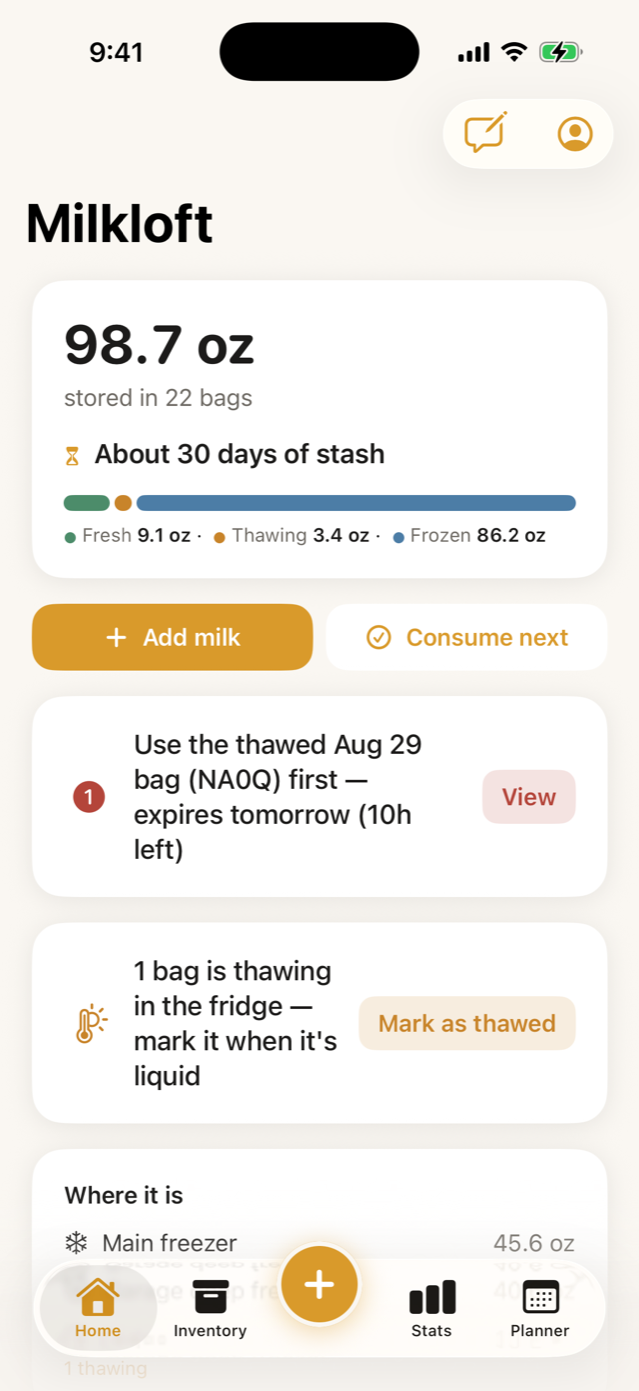
One last honesty note about this page. We wrote the prompts because assistants are already where a lot of these questions get asked at two in the morning, and a mother deserves an answer with a source attached. The app exists because the assistant will not remember, tomorrow, which bag you were told to use tonight.
Sources
- CDC · Storage and Preparation of Breast Milk, checked 2026-09-03.
- ABM Clinical Protocol #8 · Human Milk Storage Information for Home Use for Full-Term Infants (Revised 2017), checked 2026-09-03.
- NHS · Expressing and storing breast milk, checked 2026-09-03.
Frequently asked questions
Can ChatGPT or Claude keep track of my breast milk stash?
Not reliably. An assistant has no memory of your freezer between conversations, no notification when a bag is close to its estimated limit, and no way to check that what you told it last week is still true. It is good at explaining a guideline and at arithmetic you hand it. The inventory itself needs something that keeps the list.
Is it safe to paste my Milkloft export into an AI assistant?
That is your call, and it is a real one: pasting the file sends its contents to whoever runs the assistant, under their terms, and it may be kept. The export includes the times you pumped and any notes you wrote. If you want to try it, paste a trimmed section rather than the whole file.
Does Milkloft use AI?
No. Every figure in the app comes from a guideline table you can read, and every projection is arithmetic we can show you. Nothing you log is sent to a model, because nothing you log is sent anywhere.
Do you have an API, an MCP server or Shortcuts support?
No. Milkloft has no backend, so there is nothing to expose and no key to issue. The JSON and CSV export is the open format, and it is free. If you are building something with it, write to us.
Why do assistants get breast milk storage wrong so often?
Because the guidelines differ, most of the web mixes them, and the gaps are invisible: where a guideline publishes no figure, the internet supplies one anyway. Asking for the source per number, and for "no published figure" as an allowed answer, fixes most of it.