Breast milk instructions for daycare and caregivers
Updated Sources checked
Breast milk instructions for daycare or a caregiver need four answers, and they fit on one page: which bag to use first (the oldest), how much to give, how to warm it (lukewarm water, never the microwave), and what happens to what is left in the bottle (within 2 hours from the start of the feed, per the CDC, then discard). Below is what each line should say, and a free printable sheet with a place to write it. Times here are estimates from published guidelines, not medical advice.
Short answer
Estimates per CDC · not medical advice
What the other person actually needs on one sheet
The person feeding your baby is not memorising a storage chart. They are holding a baby in one hand at 11 AM. So the sheet answers their questions in the order they arrive, and it answers them about today's bags, not about milk in general.
- Which bag, in what order. Number them 1 to 5 rather than listing dates. Oldest first is the rule; a number is the version of it a tired person can follow.
- How much per bottle. Not the day's total. A caregiver pours a bottle, not a spreadsheet. The daycare amount guide works out the per-bottle figure from your hours apart.
- How to warm it. Two sentences, because this is where accidents happen.
- What to do with what is left. The 2-hour clock, and what to send home instead of tipping down the sink.
- Who to call. One number. It turns a judgment call into a question.
How to warm breast milk (and why never the microwave)
Thaw in the fridge, or hold the bag or bottle under lukewarm running water. Never the microwave and never boiling water: the CDC's guidance is explicit that microwaving creates hot spots that can burn a baby's mouth, and it heats unevenly enough that a swirl does not fix it. Swirl gently to mix the cream layer back in. Milk that has separated into layers is normal, not spoiled.
Body temperature is warm enough, and per the CDC milk does not need to be warmed at all; plenty of babies take it straight from the fridge. Warming is a preference, and it costs something: per the CDC, milk that has been brought to room temperature or warmed should be used within 2 hours, whether or not anyone drinks it. So warm one bottle, not the day's supply.
What to do with what is left
| Situation | CDC | NHS |
|---|---|---|
| Baby drank from the bottle | Use within 2 hours, then discard | Use within 1 hour, then throw away what is left |
| Warmed, nobody drank | Use within 2 hours | The NHS publishes no figure for this |
| Thawed, stayed cold in the fridge | Use within 24 hours from fully thawed | "Use it straight away"; the NHS publishes no hour figure |
| Milk that has thawed | Never refreeze after it has thawed | Do not re-freeze milk that has been defrosted |
Sources checked 2026-09-03. The 2-hour leftover window counts from the start of the feed, not from when the baby let go, which is why the sheet has a space for the time the bottle was offered. The unfinished-bottle guide covers the case where the baby takes half and falls asleep, including the part still in the bag that was never poured and keeps its own date.
Labels a stranger can read
A caregiver reading four bags of handwritten dates at the back of a shared fridge is doing the one job you did not intend to give them. Full name, date expressed, amount, and a number that matches the sheet: that is the whole label. Most daycares ask for the name and the date; some want the time as well, and their rules come first. The labelling guide covers what to write, which markers survive a freezer, and a printable label sheet.
The free printable sheet
One page, blank, with room for five bags: code or label, amount, the date on the bag, the estimated use-before date, and a tick box for what was actually fed. Underneath: how to warm it, what to do with what is left, the rules that save the most milk, and a line for your phone number. The PDF has the same sheet twice, A4 first and US Letter second, so it prints correctly wherever you are. No email, no sign-up.
Download the caregiver sheet (PDF, A4 + Letter, free, no email)
Fill it in the night before, with the bags you already moved to the fridge. That is the same evening decision the 24-hour thaw clock is built around: a bag thawed tonight is good for about a day from the moment it turns liquid, which is one daycare day.
The sheet the app fills in for you
The blank version above is the whole idea, and it works with a pen. What Milkloft Pro adds is that the app already knows your bags, so the sheet arrives with the order, the amounts, the approximate times and a scannable code per bag, and the use-before dates come from the guideline you picked rather than from mental arithmetic at 6 AM.
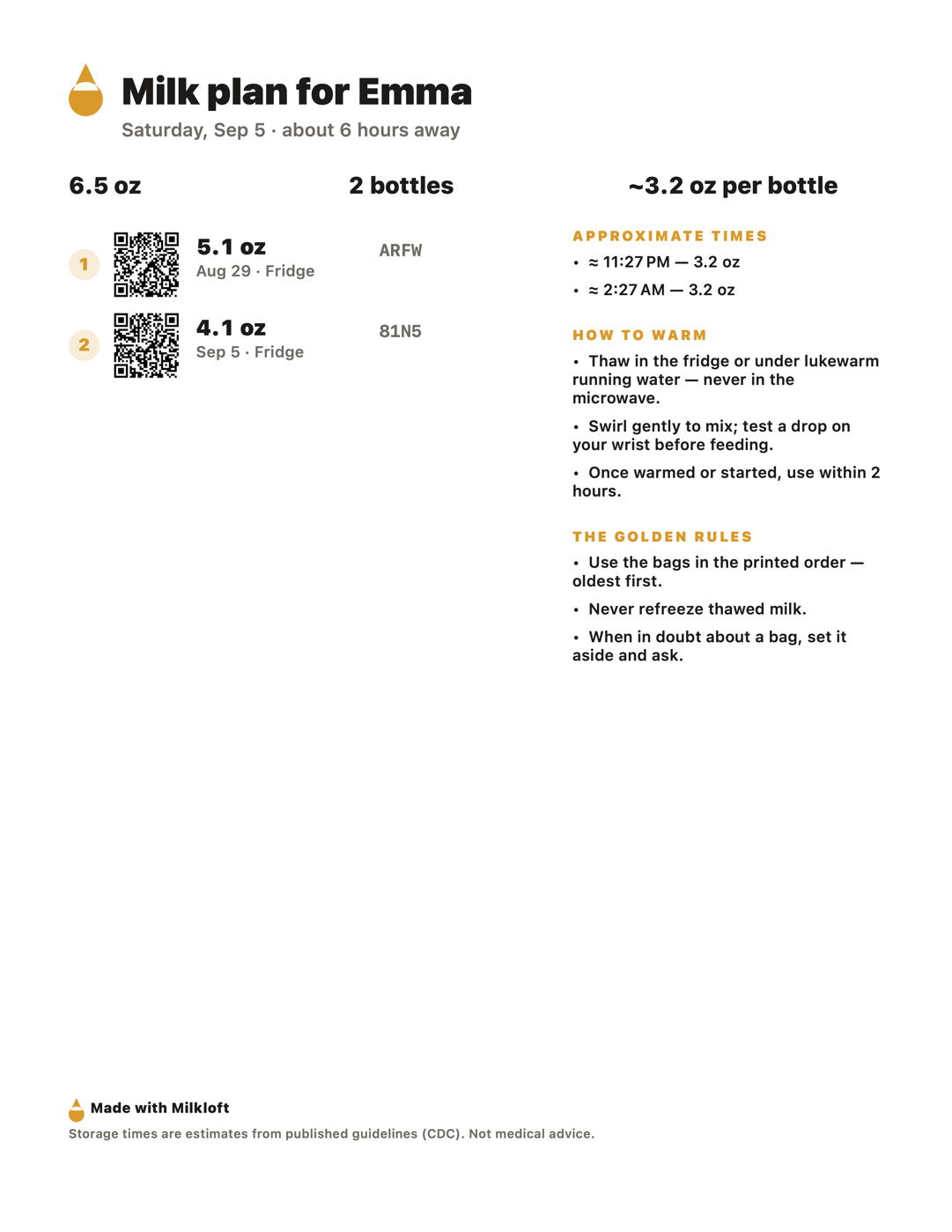
Milkloft is an iPhone app for the breast milk you pump and store. It knows which bag is oldest, so the sheet it prints with Pro is already in order; it puts a scannable code on every bag, so nobody is deciphering handwriting; and every use-before date on it is an estimate from a cited, editable guideline. One purchase, no subscription, no account, and the person feeding your baby never needs the app.
Frequently asked questions
What should breast milk instructions for a babysitter say?
Four things, in this order: which bag to use first (the oldest), how much to give, how to warm it (fridge or lukewarm running water, never the microwave), and what to do with what is left (use within 2 hours from the start of the feed, per the CDC, then discard). A phone number for questions is the fifth. The printable sheet on this page has a line for each.
Does daycare require a name and a date on every bag?
Most do, and many ask for the time as well, but the rules vary by centre and by region, so check with yours. Writing the baby's full name, the date the milk was expressed and the amount covers what daycares usually ask for. If your centre has its own label or its own form, theirs comes first.
How do I know the caregiver used the oldest bag first?
Number the bags on the sheet instead of trusting the dates to speak for themselves. A caregiver reading "1, 2, 3" does not have to compare four handwritten dates in a hurry. A tick box next to each number tells you at pickup which bags were actually used, and which came home.
Can an unopened bottle go back in the fridge?
If it was never warmed and the baby never drank from it, yes: it keeps its own clock. Milk that was brought to room temperature or warmed should be used within 2 hours per the CDC, warmed or not. Thawed milk that stayed cold keeps up to 24 hours from fully thawed. Once the baby has drunk from the bottle, the 2-hour leftover row takes over and the milk does not go back.
Does the caregiver need the app?
No. The sheet is the interface, and the printable version on this page is free, needs no email and works with a pen. With Milkloft Pro, the app fills the same sheet in with your real bags and puts a scannable code on each one, which is convenience for you, not a requirement for them.
Sources
Keep reading
- How to label breast milk bags (and why a QR beats a Sharpie)
- How many ounces of breast milk for daycare?
- Baby didn't finish the bottle: save it or dump it?
- How much breast milk should I have saved before going back to work?
- Going back to work while breastfeeding: a step-by-step plan
- Milkloft for going back to work
- Milkloft: the intelligent inventory for your breast-milk stash
- All guides