Flying with breast milk: the rules, the cooler clock, and what happens at security
Updated Sources checked
In the United States you can take as much breast milk through security as you need to: the TSA exempts it from the 3.4 oz (100 ml) liquids rule, it does not have to fit in a quart-sized bag, and your baby does not have to be with you. Ice packs and frozen gel packs are allowed too, even part-melted. Two things this guide will keep repeating: the rules are not the same in every country, so check your departure airport, and the storage clock does not pause for a flight. A cooler with frozen ice packs is estimated at up to 24 hours, per the CDC, whether that time is spent at home or in an overhead bin.
Short answer
TSA and GOV.UK checked 2026-09-08 · storage estimates per CDC · not medical advice
What the TSA actually says
Every line here was read off the TSA's own pages on 2026-09-08. It applies to airports in the United States.
| Rule | What the TSA publishes |
|---|---|
| How much you may carry | Breast milk in quantities greater than 3.4 oz (100 ml) is allowed in carry-on baggage and does not need to fit in a quart-sized bag. The TSA publishes no maximum. |
| Flying without the baby | Your child does not need to be present or travelling with you to bring breast milk. |
| Ice and gel packs | Ice packs, freezer packs and frozen gel packs are allowed in carry-ons, whether or not there is breast milk with them. If they are partially frozen or slushy, they get the same screening. |
| Say so at the start | Tell the TSA officer at the beginning of screening that you are carrying breast milk in excess of 3.4 oz. |
| Screened separately | Take the milk out of your carry-on so it can be screened apart from your other belongings. |
| Containers | The TSA recommends clear, translucent bottles rather than plastic bags or pouches, which speeds screening up. |
| If you would rather it were not X-rayed | Tell the officer: you can decline to have the milk X-rayed or opened. Liquids in bags or pouches may then need alternate screening, and nothing is ever put into the milk. |
Notice the shape of that list: it is about procedure, not permission. There is no application, no letter from a doctor and no published maximum. The only thing asked of you is to say what you have at the start and let it be screened on its own.
Before you fly: how much, and in what state
The amount question is the same one daycare asks, just with a flight in the middle: what your baby drinks while you are apart. The daycare guide has the cited per-hour rule; count the door-to-door hours rather than the flight time, because the airport and the drive at both ends are part of the trip.
The state the milk is in decides everything else:
- Fresh, already chilled is the simplest for a day trip. It rides in a cooler and lands still inside the fridge window if the trip is short.
- Frozen is the right choice for anything longer, and for milk you want to put back into a freezer at the other end, provided it is still frozen with ice crystals when you arrive (CDC). It also survives a delay better, because a solid block warms more slowly than a bottle.
- Half and half is the trap. A frozen bag riding next to a warm one is a bag that starts thawing. Pack the frozen ones together, in the middle, with the packs around them.
At security: what to say, and what happens next
Say it before the bins, not after. "I have breast milk, more than 3.4 ounces" is the whole script, and it is the step the TSA asks for. Then take the milk and the packs out of your bag so they can be screened separately.
From there, expect the milk to be tested for explosives or prohibited items rather than opened; the TSA's X-ray machines, it says, are not harmful to food or medicine. If you would rather it were not X-rayed or opened, say so, and be ready for alternate screening such as explosive trace detection or vapour analysis. Milk in clear, translucent bottles tends to clear faster than milk in pouches, which is the TSA's own recommendation and the reason to decant before you leave home rather than at the belt.
One more practical note: keep every bag labelled with its date. Not for security, which does not care, but for you, three hours later, deciding which one to open. The labelling guide covers what to write.
In the air: the cooler is the clock
Once you leave the house, the only storage figure that matters is the cooler one, and all three guidelines agree on it: up to 24 hours in an insulated cooler with frozen ice packs, per the CDC; the ABM and the NHS publish the same 24 hours.
Two details make that number behave differently from how people expect. First, it is a cap on top of whatever the bag already was: a frozen bag in a cooler stops advertising six months, and a fresh one stops advertising four days, because a cooler is cold and is neither a fridge nor a freezer. Second, and this is the one that catches people on trips with several legs, the window does not restart when you re-pack. A bag that spent the morning in a cooler, an hour in a hotel fridge and then another afternoon in the cooler has used two chunks of the same 24 hours, not one fresh window each time.
On arrival: put it away, then triage
Get the milk into a fridge or freezer before you unpack anything else. Then sort it by what it is now, not by what it was when you left:
- Still frozen, with ice crystals. Per the CDC's emergency guidance, milk that started to thaw but still has ice crystals counts as frozen and can be refrozen. Milkloft applies a knowingly stricter rule and never returns a bag to the freezer once it has left one; if you follow the CDC's reading instead, put those bags at the front so they get used first.
- Fully thawed, no crystals. This is fridge milk now: use within 24 hours from fully thawed, and never refreeze after it has thawed. The thaw clock guide explains where the 24 hours starts.
- Fresh milk that stayed cold. It keeps its original window; the cooler hours it spent are a cap on that window, not a reset of it.
The outage guide walks a whole stash through the same ice-crystal question bag by bag, which is the closest published analogue to a suitcase that took longer than planned.
Flying home with milk, and what goes in the hold
Coming back is usually harder than going, because you are carrying more than you left with. Freeze what you can the night before, pack it solid and in the middle, and give yourself a plan for the milk that does not fit in the cooler.
Checked baggage is where the country you are in starts to matter. In the UK, GOV.UK is explicit that frozen breast milk is not allowed in hand luggage, though it can travel in hold luggage. That is the opposite of the TSA's position, from two authorities read on the same day, 2026-09-08, which is exactly why a page like this should not generalise. Dry ice is a third case again. The TSA says to check with your airline. The FAA limits you to 5.5 pounds of dry ice, properly packaged in a vented package and marked, and airline approval is required.
Outside the United States, assume nothing
The TSA governs airports in one country. Here is the same handful of questions answered by GOV.UK for the United Kingdom, to show how far the answers can move:
| Question | GOV.UK (United Kingdom) |
|---|---|
| Frozen breast milk | Not allowed in hand luggage. It can go in hold luggage. |
| Container size | Individual containers of breast milk must hold no more than 2,000 ml. |
| Flying without the baby | Breast milk may be carried without the baby; formula milk, sterilised water and baby food require the baby to be travelling. |
| Screening | Every container is screened, and staff may need to open containers. |
| Cool packs | Cooling gel packs and ice packs are allowed in hand luggage. |
Those are the only two authorities this page has read. For anywhere else, the honest answer is that we do not know and will not guess: check the security rules published by your departure airport and your airline before you pack, and remember that a connecting flight can mean a second set of rules at the transfer airport.
What the app does with a trip
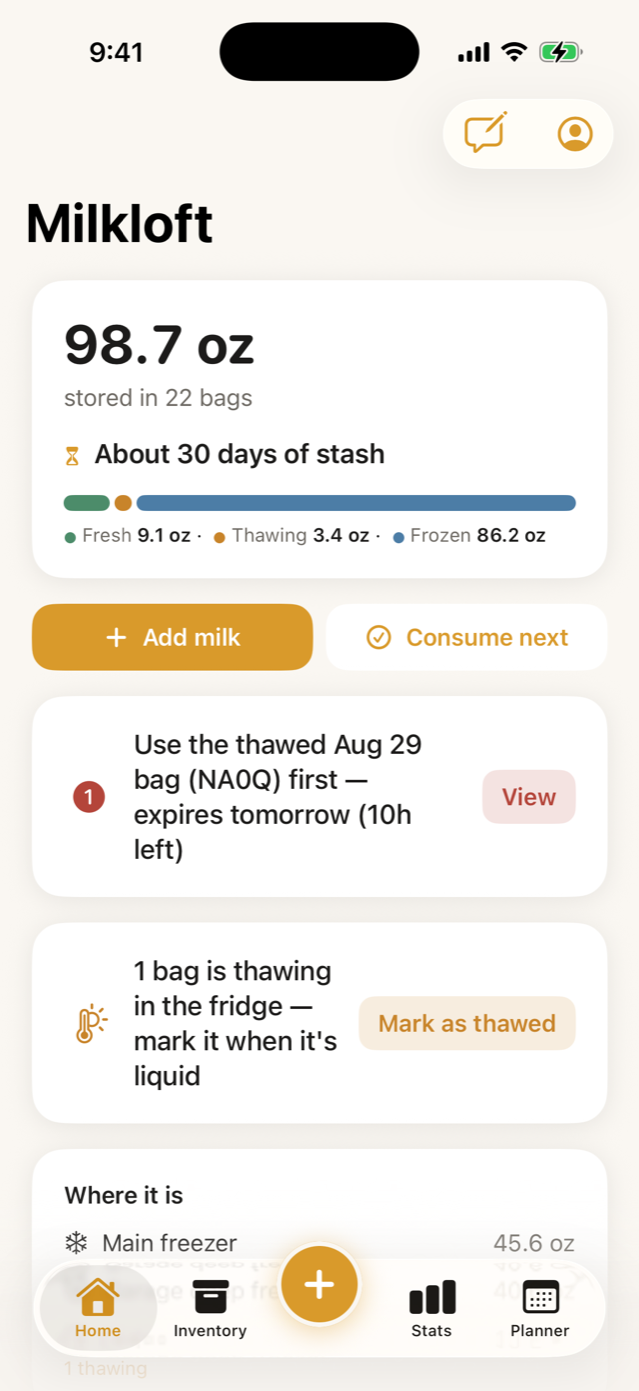
Milkloft is an iPhone app for the breast milk you pump and store, and a trip is a location in it like any other. Make one of type cooler and the bags you move into it take the 24-hour window as a cap on whatever they already had, which is what makes a frozen bag stop showing six months while it is out of the freezer.
The part worth knowing is that cooler time adds up across trips. Moving a bag out of the cooler banks the finished stint and pauses the clock rather than rewinding it, so a bag that travels every week can never collect more than one full window over its whole life. That is the strictest reading of a source that gives one figure for one trip and says nothing about repeating it, and it is deliberately more cautious than a per-trip reset would be.
Security rules here are the TSA's and GOV.UK's own, read on 2026-09-08, and they change without notice: check them again close to your trip. Storage figures are estimates from published guidance, never medical advice, and every date is an estimate rather than a guarantee.
Frequently asked questions
Can I fly with breast milk without my baby?
In the United States, yes: the TSA says your child does not need to be present or travelling with you to bring breast milk. The UK draws the same line for breast milk specifically, while formula, sterilised water and baby food there do require the baby to be travelling. Both were checked on 2026-09-08.
Can you bring frozen breast milk on a plane?
It depends on where you are flying from, and this is the clearest example of why. The TSA allows breast milk and the frozen gel packs cooling it in a US carry-on, part-melted packs included. GOV.UK says you cannot carry frozen breast milk in hand luggage in the UK, though it can travel in hold luggage. Check the rules for your departure airport before you pack.
Can I take dry ice on a plane with breast milk?
The TSA says to check with your airline. The FAA limits you to 5.5 pounds of dry ice, properly packaged in a vented package and marked, and airline approval is required. In other words this is an airline question, not a security-line one, and it has to be settled before you get to the airport.
How long will frozen breast milk stay frozen in a suitcase?
Nobody publishes a figure for that, so this guide does not give one. What is published is the cooler window: up to 24 hours in an insulated cooler with frozen ice packs, per the CDC. Beyond that you are relying on how well a particular bag was packed, which no guideline measures.
Can I ask them not to X-ray my breast milk?
In the United States, yes. Tell the TSA officer if you do not want the milk X-rayed or opened; milk in bags or pouches may then need alternate screening, and the TSA says nothing is ever placed into the milk. Carrying it in clear bottles rather than pouches tends to make the whole step shorter.
Does milk that softened on the plane have to be thrown out?
Not necessarily. Per the CDC's emergency guidance, milk that started to thaw but still has ice crystals counts as frozen. Milk with no ice crystals left has thawed: it goes in the fridge, is estimated to keep 24 hours from fully thawed, and is never refrozen. Milkloft itself is stricter and never sends a bag back to the freezer once it has left one.
Sources
Keep reading
- Power went out? A bag-by-bag triage for your freezer stash
- The 24-hour thaw clock: when thawed breast milk actually expires
- How to label breast milk bags (and why a QR beats a Sharpie)
- Why Milkloft is one purchase, not a subscription
- Milkloft: the intelligent inventory for your breast-milk stash
- All guides