How long will my freezer stash last?
Updated Sources checked
How long a freezer stash lasts is the milk you have stored divided by what your baby takes from it on a feeding day, and with the cited rule of 1–1.5 oz per hour of separation (KellyMom) an eight-hour day is around 8 to 12 oz, so 100 oz covers roughly 8 to 12 feeding days. The catch is the second clock: frozen milk is best used within about 6 months, up to 12 months acceptable, per the CDC, so part of a large stash can reach its estimated limit before your baby reaches it. Both numbers are estimates, and this page is not medical advice or a weaning plan.
Short answer
Reference estimates · not medical advice, not a weaning plan
The simple division, and where it goes wrong
The division is honest as far as it goes. Stored milk, divided by the daily amount, gives feeding days. Then spread those feeding days across a calendar: a stash used only on workdays covers five days a week, so ten feeding days is two weeks on the wall, not ten.
What the division misses is that a stash does not only shrink from the front. It also ages from the back. Every bag carries the date it was frozen, and the CDC's freezer row reads "about 6 months is best; up to 12 months is acceptable". If your consumption date lands after the oldest bags' estimated limit, the milk at the bottom of the freezer is on a different clock from the milk you are counting.
How much your baby takes a day
The figure this page uses is KellyMom's rule of thumb for expressed milk while you are apart: 1 to 1.5 oz per hour of separation, for a baby who is otherwise breastfed and roughly one to six months old. It is a range because babies are a range, and it stops fitting once solids arrive and the amount trends toward the lower end. The daycare amount guide covers how that plays out bottle by bottle, and why the number barely moves with age.
If you already know what your baby takes, use that instead. Your own number beats a rule of thumb every time, and the calculator takes it.
Run your own numbers
Enter what you have stored, how long you are away, and how many days a week the stash is actually used. Add the date on your oldest frozen bag and the tool will tell you which arrives first: the last bag, or that bag's estimated freezer limit.
How long will my stash last?
The other clock
A reference estimate, not medical advice and not a weaning plan. It assumes the amount your baby takes stays roughly steady, which it will not: needs change with age, with solids, and with how much you keep pumping. Talk to your pediatrician or an IBCLC before you change how often you pump.
KellyMom · How much expressed milk will my baby need? · CDC · Storage and Preparation of Breast Milk · checked 2026-09-03
Three ways the number comes out
| Situation | What changes | What to do with the result |
|---|---|---|
| You pump at work as usual | The stash barely moves: most days are covered by what you pumped the day before | Treat the stash as a buffer, and rotate it so it does not age in place |
| You pump less than the baby takes | The stash covers only the gap, so it lasts far longer than a full-day division suggests | Enter the gap, not the day's total, in the calculator |
| You have stopped pumping | The stash covers the whole day and empties at the full rate | Check the oldest bags first: this is where the two clocks collide |
In all three, the milk to use is the oldest that is still inside its estimated window. The rotation guide covers the weekly habit that keeps a large stash from quietly ageing at the back, and the organizing guide covers making the oldest bag the easiest one to reach.
What "when can I stop pumping" means here, and what it does not
People arrive at this question two ways. One is arithmetic: if I stop now, does the milk I have cover the days I need? That part the calculator answers, and it is the only part this page answers.
The other is a decision about weaning from the pump, and it is not arithmetic. It involves your supply, your baby's age, whether solids have started, how your body responds to dropping sessions, and how you feel about it. None of that is on this page, and no guideline we cite publishes a rule for it. That conversation belongs with your pediatrician or an IBCLC, who can see the things a division cannot.
What the arithmetic is genuinely good for is taking the fear out of the question. A stash that covers three weeks is three weeks of information you did not have, and it is usually more coverage than it felt like from the outside of the freezer door.
What the app does with it
Milkloft runs this projection continuously instead of on demand, because it already knows every bag: how much, frozen when, in which freezer. The home screen carries the answer as a line rather than a chart, and the bags that would reach their estimated limit before you get to them are the ones it puts in front of you first.
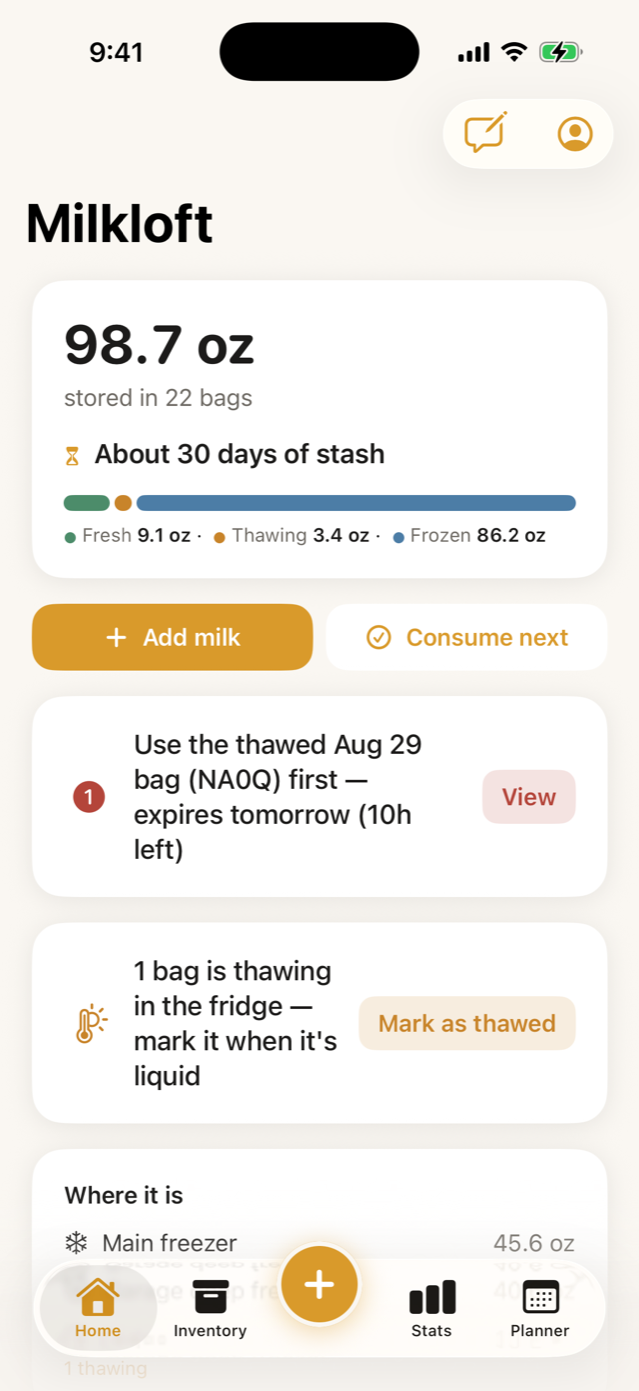
Milkloft is an iPhone app for the breast milk you pump and store. It knows what each bag holds and when it was frozen, so the days-of-stash figure moves as you log and use milk, and the Return-to-Work planner (Pro) projects the same arithmetic forward against the date you go back. Every limit it shows is an estimate from a cited, editable guideline, and none of it is medical advice.
Frequently asked questions
How long will my freezer stash last?
Divide what you have stored by what your baby takes from the stash on a feeding day. With the cited rule of 1 to 1.5 oz per hour of separation (KellyMom), an eight-hour day is roughly 8 to 12 oz, so 100 oz stored covers something like 8 to 12 feeding days. Spread over a five-day week, that is two to three calendar weeks. It is arithmetic, and it is an estimate.
Do I count the bags in the fridge?
Count them separately. Fridge milk is on a 4-day clock per the CDC, so it is this week's milk rather than reserve, and it will be used long before the frozen bags. The number worth tracking is the frozen stash, with fridge milk as today's supply on top of it.
What if my supply drops?
Then the stash covers the gap rather than the whole day, and it empties faster than the division says. Re-run the numbers with what you are actually pulling from the freezer each day rather than with the full daily amount. A drop that worries you is worth raising with an IBCLC or your pediatrician, not solving with a calculator.
Can I use this to decide when to stop pumping?
The arithmetic part, yes: it tells you how many days the milk you already have would cover. The decision is not arithmetic. Supply, your baby's age, solids, and how weaning from the pump feels are all part of it, and they belong in a conversation with your pediatrician or a lactation consultant. This page does not give that advice.
How much stash is "a lot"?
No guideline publishes a number, so this page does not invent one. The useful target is coverage, not volume: enough to bridge the first days back and to absorb a bad pumping day, which is a much smaller figure than the freezers on social media suggest. The guide on how much to have saved before going back to work works it out from your own hours.
Sources
Keep reading
- How much breast milk should I have saved before going back to work?
- How many ounces of breast milk for daycare?
- FIFO for breast milk: rotate your stash so nothing expires
- Going back to work while breastfeeding: a step-by-step plan
- Milkloft for going back to work
- Milkloft: the intelligent inventory for your breast-milk stash
- All guides