Breast milk in a cooler bag: how long does it last?
Updated Sources checked
Breast milk keeps for up to 24 hours in an insulated cooler with frozen ice packs, and all three guidelines this site cites agree on that figure: the CDC for a cooler with frozen ice packs, the ABM for a small cooler with an ice pack, the NHS for a cool bag carrying milk that was already cooled in the fridge. The part none of them spells out is the part that matters on a Tuesday: the cooler is a cap on that leg of the trip, not a reset. Milk pumped at ten in the morning is milk pumped at ten in the morning when it reaches your fridge at six. These are estimates from published guidelines, not medical advice.
Short answer
Estimates per CDC, ABM and NHS · not medical advice
What counts as a cooler
| Guideline | What it describes | Limit |
|---|---|---|
| CDC | Insulated cooler with frozen ice packs (traveling) | Up to 24 hours |
| ABM | Small cooler with an ice pack (about 59 °F / 15 °C) | 24 hours |
| NHS | Cool bag with ice packs (milk already cooled in the fridge) | Up to 24 hours |
Sources checked 2026-09-03. Read the middle column, not just the number. Every figure describes an insulated container with frozen packs in it, kept closed. The NHS adds a condition the other two do not: the milk went into the bag already cold. None of them publishes a figure for a bag with no ice packs, or for one that spent the afternoon in a hot car, so neither does this page.
Work, home, fridge: the clock does not restart
Here is the shape of an ordinary day, with the milk's own clock running underneath it. The cooler caps the middle stretch. It does not hand back the hours the milk has already spent being milk.
That is why a daily commute never stacks up: a trip that takes eight hours cannot use more than one 24-hour cooler window, and the fridge row it lands in (up to 4 days, CDC) is counted from when the milk was pumped, not from when it came home. The expiration calculator does that arithmetic under whichever guideline you follow.
Frozen milk in a cooler
A frozen bag in a cooler is not on the cooler row at all while it is still frozen. It is frozen milk, and the question is only whether it stayed that way. The CDC's emergencies guidance gives the test: still counts as frozen; it can be refrozen (cdc), so a bag that softened at the edges but still has crystals in it can go back in the freezer. A bag that is fully liquid cannot: it is thawed milk now, on the 24-hour window from the thaw clock.
Milkloft is stricter than the CDC on this one point, on purpose: in the app, a bag that left the freezer is never put back, because a phone cannot see whether there is ice left in it. That is the app's rule, not the guideline's, and the app says so.
Which bag goes to daycare
The oldest one still inside its estimated window, and no more than the day needs. A cooler ride is time spent, so a bag that is already near its limit is the wrong one to send out of the house, however convenient it is to reach. Send it with a sheet that says which bottle comes first, which is what the caregiver instructions are for, and label it so nobody has to guess: the labelling guide covers what daycares tend to ask for.
What the app does
Milkloft treats a cooler as a place, the same way it treats a fridge or a freezer, because that is what it is: a bag lives there for a while and then moves on. Logging that move keeps the bag's real age intact, so what you see at home is the limit counted from when you pumped, with the cooler leg capped rather than added.
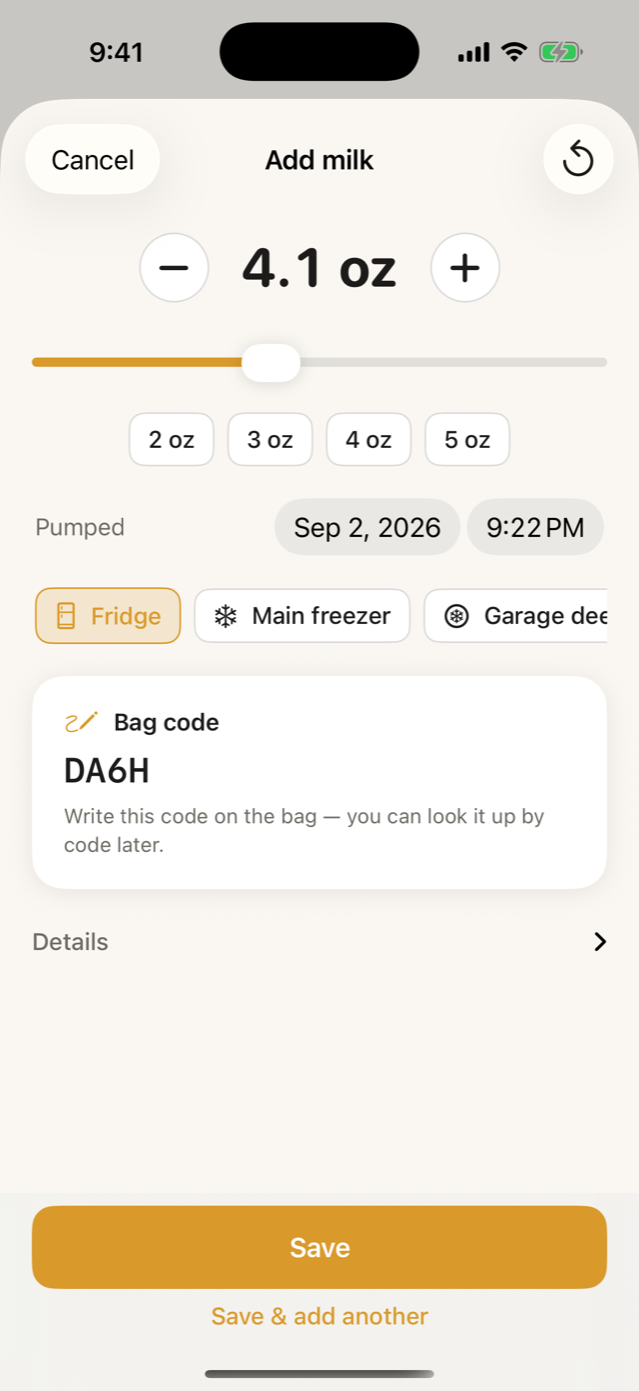
Milkloft is an iPhone app for the breast milk you pump and store. Give it a Cooler location and a bag that travels carries the 24-hour cap for that leg without losing the age it already has, so the limit you see at home is the honest one. Every date is an estimate from a cited, editable guideline, and none of it is medical advice.
Frequently asked questions
How long does breast milk last in a cooler bag?
Up to 24 hours in an insulated cooler with frozen ice packs, per the CDC. The ABM gives the same 24 hours for a small cooler with an ice pack, and the NHS gives 24 hours for a cool bag carrying milk that was already cooled in the fridge. All three agree on the figure. What none of them says is that the cooler gives the milk fresh time: the milk keeps ageing on its own clock.
Can I use a regular lunch bag?
The guidelines describe an insulated cooler with frozen ice packs, not an uninsulated bag. A lunch bag with a frozen ice pack inside is closer to the described setup than the same bag empty, but you cannot check the temperature, so treat it as less reliable rather than as the same thing. The NHS wording is stricter still: it describes a cool bag with ice packs carrying milk that came out of a fridge already cold.
How many ice packs do I need?
No guideline we cite publishes a number, so this page does not give one. The CDC and the ABM describe frozen ice packs keeping the milk cold, without saying how many. In practice, enough to keep the packs still cold at the end of the trip and to fill the empty space, since air warms faster than anything else in the bag.
What if the ice packs melted?
Then the condition the 24-hour figure describes has not held for the whole trip, and you do not know for how long it was warm. Treat it as a judgment call rather than as a number: a short, mostly cold trip is different from a bag left in a hot car. If the milk is warm to the touch, the cooler window is not what decides. When in doubt about a specific bag, ask your pediatrician or an IBCLC.
Can I freeze milk that travelled in a cooler?
If it was fresh milk that stayed cold and never thawed, yes, as long as you freeze it inside its own window rather than at the end of it. If it was frozen milk that fully thawed on the way, no: the CDC and the NHS both say thawed milk is never refrozen. A frozen bag that still has ice crystals still counts as frozen under the CDC emergencies guidance, so it can stay in the freezer.
Sources
Keep reading
- Breast milk storage chart (CDC guidelines)
- Breast milk expiration calculator (CDC, ABM & NHS rules)
- Breast milk instructions for daycare and caregivers
- The 24-hour thaw clock: when thawed breast milk actually expires
- The best breast milk tracking apps, compared on what you can check
- Milkloft: the intelligent inventory for your breast-milk stash
- All guides