Breast milk inventory log: a printable sheet and a spreadsheet that does the dates
Updated Sources checked
A breast milk inventory log needs four columns, and the fourth is the one most sheets leave out: the date you pumped it, how much, where it is, and the estimated use-by date. The first three record what you have. Only the fourth answers the question you actually open the freezer with, which is not how much milk is in there but which bag to use tonight. Below: a printable sheet with those columns, and a spreadsheet that fills the fourth one for you from the CDC figures.
Short answer
Use-by figures per CDC, checked 2026-09-03 · estimates, not medical advice
The four columns, and the one everyone forgets
Most logs people share online have two columns, date and volume, because those are the two things you know while you are still holding the bag. They produce a running total and nothing else. The two that turn a list into a decision are the ones you have to look up.
- Pumped (date and time). The one input every published limit counts from. The time matters for anything measured in hours, which is most of the table.
- Volume. Ounces or millilitres, one unit for the whole sheet. It is what tells you whether a bag covers a feed.
- Location. Not decoration: the limit changes completely between the fridge door and the deep freezer, and a stash that lives in two appliances needs the column to stay honest.
- Use by (estimated). Pumped date plus the limit for that location. It is the only column you can sort by to get the answer, and it is the one that has to be recomputed every time a bag moves.
Download the sheet and the spreadsheet
Both are free, both are yours, and neither asks for an email address. That is not a promotion; a sheet you have to trade your inbox for is a worse sheet.
Printable log (PDF, A4 + Letter) Spreadsheet (CSV, formula included)
The PDF holds the same sheet twice, once on A4 and once on US Letter, so one file works on either printer. It has 24 rows, a strip of the CDC's estimated limits so you can fill the fourth column by hand, and a line about what to do when a bag holds several sessions.
The spreadsheet is a plain CSV that opens in Numbers, Excel and Google Sheets. Its use-by column is a real formula, already filled down, so a row computes itself as soon as you type a date and a location.
How the use-by formula works
It is one line of arithmetic on a published table, and you can read all of it. Type a location from the list and the formula adds that location's estimated limit to the pumped date and time:
| Type in "Location" | What the formula adds (CDC, estimated) |
|---|---|
| Room | Up to 4 hours |
| Cooler | Up to 24 hours, with frozen ice packs |
| Fridge | Up to 4 days |
| Thawed | Use within 24 hours from fully thawed |
| Freezer | About 6 months is best; up to 12 months is acceptable |
Three details are worth knowing before you trust a row. Freezer rows use the 6-month figure, the one the CDC calls best, not the 12-month outer bound; if you want to see that bound, add six months yourself. A "Thawed" row counts from a different moment: put the time the bag finished thawing in the date and time columns, not the time you pumped it, because that is where use within 24 hours from fully thawed starts. And anything you type that is not on the list leaves the column blank rather than guessing, which is the same rule the rest of this site follows: where a guideline publishes no figure, nothing gets invented.
The part that breaks: keeping it current
Every stash log fails in the same place, and it is not the setup. It is the Tuesday you move three bags from the deep freezer to the fridge on your way out the door, and the Thursday you thaw one at 23:00 with a baby on your hip. The sheet does not follow milk around; you do, from memory, later.
Three habits keep a paper or spreadsheet log alive longer than most:
- Write the row while you are bagging, not at the end of the day. The row you promise yourself you will add later is the row that never gets added.
- Sort by the use-by column, never by the date you pumped. They look the same until a bag moves between a fridge and a freezer, and then they disagree by months.
- Cross a row out when the bag is gone. A log with used bags still in it does not just overstate the stash, it points at milk that is not there.
The other half of the job is on the bag itself. A row is only findable if the bag carries a code you can match to it; the labelling guide covers what to write and why a scannable code beats a marker.
When a spreadsheet stops being enough
A sheet is a good answer for a small, still stash. It gets thin in four situations, all of them normal:
- Two freezers. The kitchen freezer and the garage deep freezer are one stash and two rows-worth of bookkeeping, and the oldest bag is rarely in the one you are standing in front of.
- Daycare. Bags leave the house and come back, some of them unopened, and the cooler on the way has a window of its own: up to 24 hours per the CDC.
- Travel. A trip moves the whole question from "where is it" to "how long has it been out of the freezer", and no sheet recalculates on its own.
- Night feeds. The moment the sheet is most needed is the moment nobody is going to open a laptop.
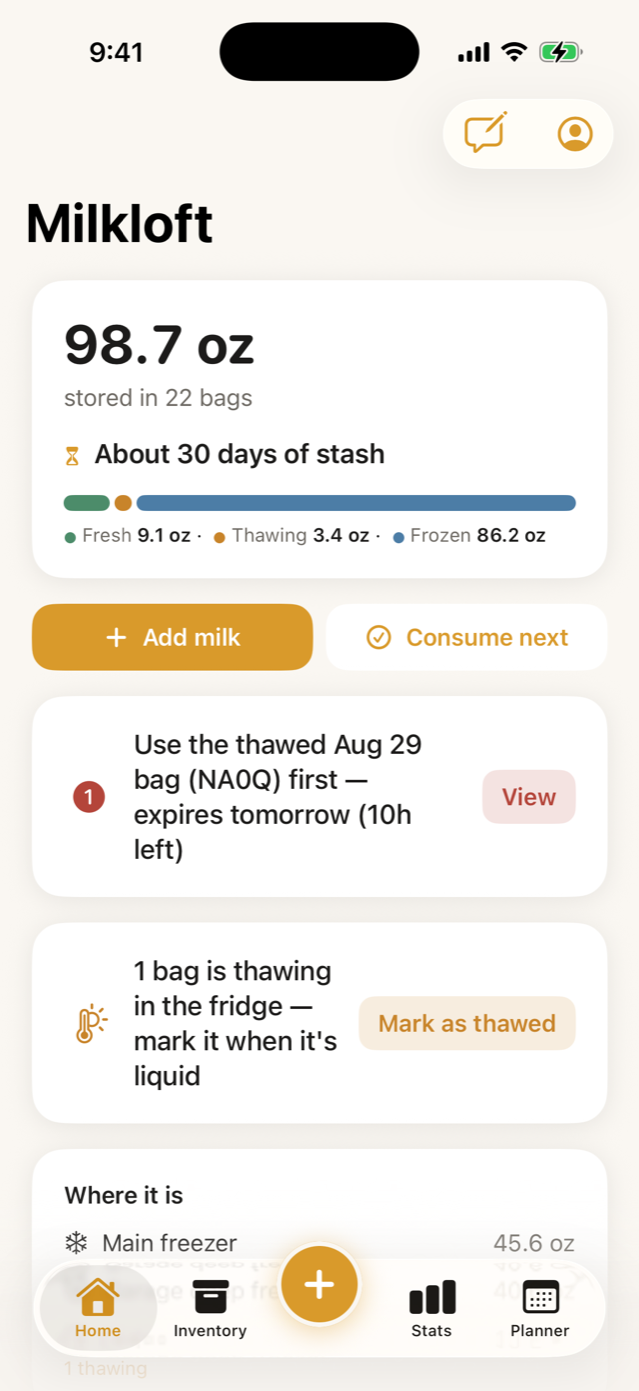
The app is the sheet that keeps itself
Milkloft is an iPhone app for the breast milk you pump and store, and it is this log with the arithmetic already done. Every bag carries its date, volume and location; the estimated limit is recomputed whenever a bag moves, from the guideline you chose (CDC by default, switchable to ABM or NHS, with the source shown); and the home screen sorts the stash so the bag to use next is the first thing on it, rather than something you derive from a column.
Two things about it belong on a page about spreadsheets. CSV and JSON export are free, not a paid tier: the records are yours, and you can pull them back into the spreadsheet above whenever you want. And there is no account and no server; the data lives on the phone and in your own iCloud, which is the same privacy a sheet on your fridge has, with the arithmetic added.
Everything on this page and in both downloads is an estimate from published guidance, never medical advice, and every date is an estimate rather than a guarantee. When a specific bag worries you, your pediatrician or an IBCLC is the right call.
Frequently asked questions
Are the log and the spreadsheet really free?
Yes, both, with no email address and no sign-up. The PDF holds one sheet on A4 and the same sheet on US Letter, so one download covers either printer. The spreadsheet is a plain CSV that opens in Numbers, Excel and Google Sheets.
Does the spreadsheet formula work in Google Sheets and Numbers?
It uses IFS, TIME and EDATE, which all three programs support. If your spreadsheet shows an error instead of a date, your locale separates function arguments with a semicolon: replace the commas inside the formula with semicolons and it will compute.
What do I write for a bag that holds milk from several pumping sessions?
The date and time of the oldest milk in it. A combined bag reaches its estimated limit when that portion would have, so dating it from the newest session makes the row read younger than the bag is.
What if I forgot to date a bag?
Then no guideline can place it, because every published limit counts from the expression date. Rather than guessing, ask your pediatrician or an IBCLC about that bag, and date the next one before it goes in the freezer.
Should the log be in ounces or millilitres?
Whichever unit you already think in; just keep one of them for the whole sheet. The English spreadsheet is in ounces and the Spanish one in millilitres, and there are about 30 ml to the ounce if you need to convert a row.
How many rows should a freezer log have?
One per bag, which is exactly why paper stops scaling. The printable sheet holds 24 rows; a stash built for a return to work usually passes that within a few weeks, and by then the useful question is not how many bags there are but which one to thaw tonight.
Sources
Keep reading
- Breast milk storage chart (CDC guidelines)
- How to label breast milk bags (and why a QR beats a Sharpie)
- How to organize a breast milk freezer stash (even across two freezers)
- FIFO for breast milk: rotate your stash so nothing expires
- Milkloft for exclusive pumpers
- Milkloft: the intelligent inventory for your breast-milk stash
- All guides