How to thaw breast milk
Updated Sources checked
The simplest way to thaw breast milk is to move the bag from the freezer to the refrigerator the evening before; if you need it now, stand it in a container of warm water or hold it under lukewarm running water. Never the microwave and never boiling water. Whichever route you take, the 24-hour clock starts when the milk is fully liquid, per the CDC, not when it left the freezer. These are estimates from published guidelines, not medical advice.
Short answer
Never the microwave (CDC) · estimates, not medical advice
Three ways to thaw, and one clock
The guidelines describe the routes, not the timings. None of the three sources this page cites publishes how long thawing itself takes, so you will not find an hour count here: what you get instead is what each route is for, and what happens to the milk afterwards.
- In the refrigerator, overnight. The least handling, and the route that fits a daycare day: a bag moved at bedtime is usually liquid by breakfast. While it is still a brick it is still frozen milk, on the freezer window.
- In a container of warm water. The one to reach for when the baby is hungry now. Stand the sealed bag in the water rather than pouring the milk in.
- Under lukewarm running water. The fastest of the three, and the most wasteful of water. Same result, same clock.
Never the microwave, never boiling water
This is the one hard rule in the whole page. The CDC's guidance is explicit that breast milk should not be thawed or heated in a microwave: it heats unevenly and creates hot spots that can burn a baby's mouth, and a swirl does not fix that. Boiling water is the same problem from the other direction. Warm is enough. Body temperature is enough, and per the CDC milk does not need to be warmed at all; plenty of babies take it straight from the fridge.
When the 24 hours start
From fully thawed. The CDC's row reads "use within 24 hours from fully thawed", and a bag that went into the fridge at 9 PM was not liquid at 9 PM. It was frozen milk on the freezer window until it turned liquid, and the 24 hours run from there. If you did not see the moment it turned, count from when it went into the fridge: that is the cautious reading, and it keeps you inside the window instead of guessing past it.
| After thawing | CDC | ABM | NHS |
|---|---|---|---|
| In the refrigerator | Use within 24 hours from fully thawed | 24 hours from thawed (the protocol counts a thawed window of 24 hours) | "Use it straight away"; the NHS publishes no hour figure |
| Warmed or at room temperature | Use within 2 hours | Not more than 2 hours | The NHS publishes no figure for this |
| Refreezing | Never refreeze after it has thawed | The ABM makes no recommendation on refreezing thawed milk | Do not re-freeze milk that has been defrosted |
Sources checked 2026-09-03. The 24-hour thaw clock guide covers the forgot-it-in-the-fridge case and the warmed window in detail, including why the two clocks nest rather than add.
How much to thaw
The smallest bag that covers the feed. Thawed milk cannot go back in the freezer, so every ounce you thaw beyond what the baby takes is on a 24-hour countdown to the sink. This is the real reason bag size matters, and the bag-size guide works out which size wastes least for your hours apart. If a feed comes up short, thaw a small top-up rather than a second full bag.
Plan tomorrow's thaw
Tell the planner when you need the milk and it works backwards, for both routes, under the guideline you pick. It adds the guideline's own window to your time; it does not estimate how long thawing takes, because none of these sources publishes that.
Thaw planner
In the fridge, overnight
In warm water, in a hurry
Every window here is an estimate from the guideline you selected, counted from the time you entered. It is not medical advice. Never thaw or warm breast milk in the microwave or in boiling water.
Which bag to move is the other half of the decision, and it is the oldest one still inside its estimated window. The rotation guide covers the weekly habit that keeps the answer obvious, and the caregiver sheet is where tonight's decision gets written down for tomorrow.
What the app does
Milkloft picks the bag and holds the clock. It knows which bag is oldest, so "move this one tonight" is a card rather than a search through the freezer, and it does not start the 24-hour window until you confirm the milk is actually liquid, because that is when the guideline starts it.
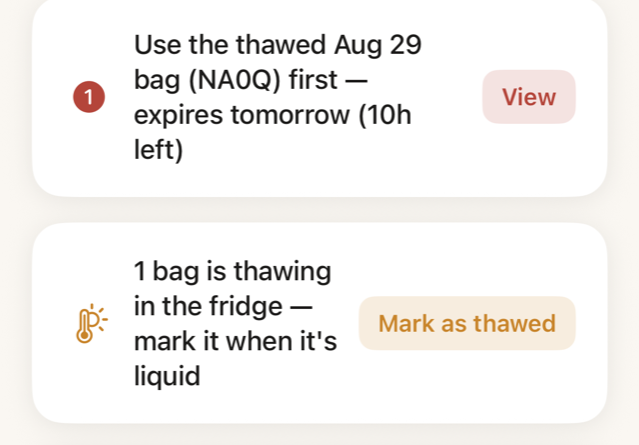
Milkloft is an iPhone app for the breast milk you pump and store. Mark a bag thawed and the 24-hour estimate starts at the right moment, with the guideline row shown beside it; warm it and the window shortens; log a feed and the bottle gets its own clock. One purchase, no subscription, no account, and every date is an estimate from a cited, editable guideline.
Frequently asked questions
Can you thaw breast milk at room temperature?
It is not one of the routes the guidelines describe. The CDC lists thawing in the refrigerator overnight, in a container of warm water, or under lukewarm running water. Leaving a bag out on the counter to thaw means the milk spends an unknown stretch warming up, and the CDC gives milk brought to room temperature 2 hours from that point. Warm water gets you the same speed with a clock you can actually read.
How long does breast milk take to thaw in the fridge?
No guideline we cite publishes a figure for this, so this page does not give one. In practice it is an overnight job, and the honest instruction is to move the bag the evening before and check it in the morning. What is published is what happens after: once it is fully thawed, the CDC gives 24 hours in the refrigerator.
Can I refreeze breast milk I thawed but did not use?
No. The CDC says never refreeze milk that has thawed, and the NHS says the same; the ABM makes no recommendation, which is not a yes. Thawed milk that stayed cold keeps up to 24 hours in the fridge from fully thawed, and then it goes. This is the main argument for thawing the smallest bag that covers the feed.
Can I warm thawed breast milk?
Yes. Warm water or lukewarm running water, never the microwave. The CDC gives warmed milk 2 hours, and that window runs inside the 24-hour thawed window rather than on top of it; none of the sources cited here publishes a figure for warming the same milk twice, so this page does not either. Once the baby has drunk from the bottle, the leftover row takes over at 2 hours from the start of the feed.
Is it normal for thawed breast milk to separate or smell different?
Separating into a cream layer and a thinner layer is normal; swirl it gently rather than shaking it. A soapy or metallic smell after freezing is something a lot of parents notice and is not covered by a storage rule. The date is what decides whether a bag is inside its estimated window. If a bag worries you, ask your pediatrician or an IBCLC.
Sources
Keep reading
- The 24-hour thaw clock: when thawed breast milk actually expires
- FIFO for breast milk: rotate your stash so nothing expires
- How much breast milk per bag? 2 oz vs 4 oz
- Breast milk storage chart (CDC guidelines)
- Breast milk expiration calculator (CDC, ABM & NHS rules)
- The best breast milk tracking apps, compared on what you can check
- Milkloft: the intelligent inventory for your breast-milk stash
- All guides