Deep freezer vs refrigerator freezer for breast milk: does it change how long milk lasts?
Updated Sources checked
A deep freezer does not buy your milk more months, at least not any that anyone publishes. The CDC, the ABM and the NHS each give one freezer figure, and it is the same one whether the appliance is a chest freezer in the garage or the freezer on top of your fridge: about 6 months is best; up to 12 months is acceptable per the CDC and the ABM, up to 6 months per the NHS, all counted from expression and all estimates. There is one real exception, and it is the opposite of the one people expect: the small ice compartment inside a fridge, which the NHS puts at 2 weeks.
Short answer
Estimates per CDC, ABM and NHS, checked 2026-09-03 · not medical advice
What the guidelines publish, and what they leave out
This is the whole table, including the rows that are empty on purpose. When a guideline publishes nothing for a condition, the cell says so rather than borrowing a number from somewhere else.
| Where the milk is | CDC | ABM | NHS |
|---|---|---|---|
| Freezer with its own door | About 6 months is best; up to 12 months is acceptable | 6 months optimal; 12 months acceptable | Up to 6 months |
| Deep freezer or chest freezer | No separate figure; the CDC freezer row applies | No separate figure; the ABM freezer row applies | No separate figure; the NHS freezer row applies |
| Ice compartment inside a fridge | The CDC publishes no figure for this | The ABM publishes no figure for this | 2 weeks |
Read the middle row again, because it is the answer to the question in the title. Neither the CDC nor the ABM publishes a separate figure for a deep freezer or chest freezer: the standard freezer row is the only published estimate. The ABM discusses freezing across a range from −4 °C down to −20 °C and still gives one duration for the whole range; the NHS names −18 °C and stops there.
Where the "12 months only in a deep freezer" idea comes from
From a sentence that got split in half. The CDC's freezer row reads "about 6 months is best; up to 12 months is acceptable", one estimate with an outer bound attached. Retold often enough, the two halves drifted apart and each found an appliance: six months for the freezer in the kitchen, twelve for the chest freezer in the garage. It is a tidy story. It is not in the source.
The reason the story survives is that it feels like it should be true. A chest freezer usually is colder and steadier, and food science does connect stable low temperature with slower quality loss. But "should be longer" is not "is published as longer", and this site only prints figures somebody published. If the difference matters for a specific bag, that is a question for your pediatrician or an IBCLC, not for a number nobody wrote down.
The real exception: the ice compartment inside a fridge
The appliance distinction that does change the number goes the other way. The NHS distinguishes a proper freezer from the small ice box inside a fridge, the kind without a door of its own, and gives the second a much shorter window: 2 weeks, against up to 6 months for a freezer at −18 °C or lower. The CDC and the ABM publish nothing for that compartment at all.
So the useful question is not chest versus upright; it is does this compartment hold 0 °F (−18 °C), and does it have its own door. If yes, it is a freezer and the 6-month estimate applies. If it is an ice box inside the fridge, it holds milk for a fortnight in NHS terms and is not where a stash should live.
Door versus back, and self-defrosting freezers
Two placement habits are worth more than the appliance argument, and neither of them involves a number:
- Bags belong at the back, never in the door. The door meets room air every time you open it. No guideline publishes a shorter figure for it, which is exactly why it deserves a habit rather than a calculation.
- A self-defrosting freezer cycles warm on purpose. That is how it stays frost-free, and it is the likeliest reason a bag comes out looking freezer-burned. A manual-defrost chest freezer does not do it. Again: a reason to prefer one for long storage, not a different date.
Freezer burn and appearance changes are described in the is it still good guide, which lands in the same place this one does: the date decides, and what you see is information.
Two freezers, one stash
Once milk lives in two appliances the interesting problem stops being duration and becomes bookkeeping. The oldest bag is rarely in the freezer you happen to be standing in front of, and the garage freezer is exactly where a bag goes to be forgotten.
- Treat each appliance as a location, not as a pile. A bag's row should say which freezer it is in, so "use the oldest" can send you to the right room.
- Move in one direction. Newly frozen milk goes to the deep freezer; bags coming due move to the kitchen freezer, where you will actually reach for them.
- Log the move. A bag that changes appliances keeps its expression date and its estimated limit; what changes is where you look for it.
- Never move a bag out through the fridge and back. Once it has left the freezer it is on the thawed clock: use within 24 hours from fully thawed, and never refreeze after it has thawed.
The freezer organization guide covers the physical half of this, and the inventory log has a location column for the other half.
Which freezer survives a power cut better?
Here too the published figures are not about the type of appliance. The CDC's emergency guidance measures fullness and whether the door stays shut: a full freezer holds temperature about 48 hours, a half-full one about 24 hours, and a fridge keeps food cold about 4 hours. Nothing there says chest or upright.
In practice a chest freezer is often the fuller of the two and is opened less, which is why it tends to come out of an outage better; that is the same two variables, not a third one. The rule that decides individual bags is the ice-crystal test, and the outage guide walks a stash through it bag by bag.
So where should the stash live?
Put the long-term stash in whichever freezer is coldest, steadiest and least opened, which for most homes is a deep freezer if there is one. Keep a small working set in the kitchen freezer so the everyday bag is within reach. Give both a place in one inventory, and keep using the oldest bag first, because that is the habit that actually prevents milk from quietly reaching its limit. The appliance is a storage decision. The date is still the date.
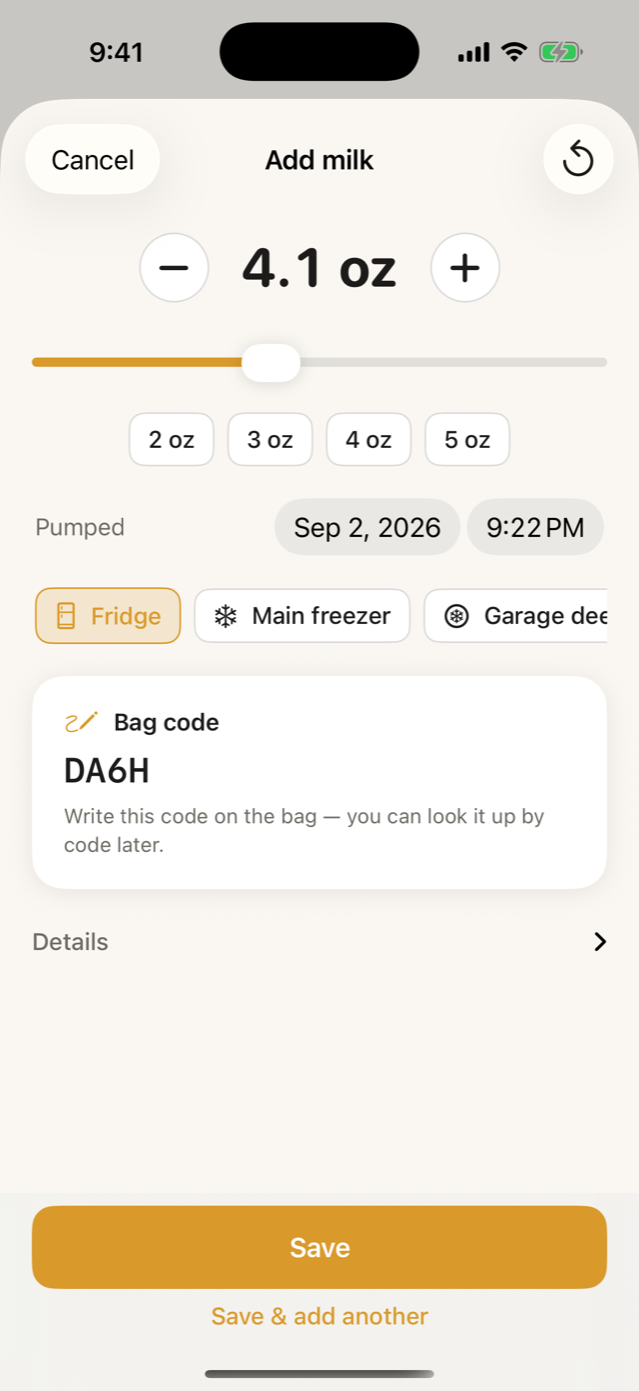
Milkloft is an iPhone app for the breast milk you pump and store, and it treats each freezer as its own location: one stash, one use-first order, and each bag's estimated limit shown with the guideline row that produced it (CDC by default, editable). It has no thermometer and does not know how cold your garage gets, and every date it shows is an estimate from published guidance, never medical advice.
Frequently asked questions
How long does breast milk last in a deep freezer?
By the published numbers, the same as in any other freezer: about 6 months is best and up to 12 months is acceptable per the CDC and the ABM, up to 6 months per the NHS. None of the three publishes a separate figure for a deep freezer or a chest freezer, so this page does not invent one. What a deep freezer plausibly gives you is a steadier temperature, which is an argument for storing there, not a longer published window.
Is a chest freezer better than an upright freezer for breast milk?
No guideline compares them, so there is no cited answer. The practical difference is that a chest freezer is opened less often and loses less cold air when it is, and that a manual-defrost freezer does not cycle warm the way a self-defrosting one does. Both of those argue for storage stability rather than for a different date.
Can I store breast milk in the freezer compartment inside my fridge?
It depends on which kind it is, and this is the one place where the appliance really does change the number. For an ice compartment inside the fridge with no door of its own, the NHS publishes 2 weeks. A freezer section with its own door that holds 0 °F (−18 °C) is treated as a freezer, so the usual 6-month estimate applies.
Why do so many pages say 12 months only applies to a deep freezer?
Because the CDC pairs one figure with an outer bound, "about 6 months is best; up to 12 months is acceptable", and repeated retellings attached the two halves to two appliances. Read the source and both halves belong to the same freezer row. The 12 months is a looser bound on the same estimate, not a reward for a colder machine.
Does the freezer door make a difference?
It is the least stable spot in the appliance, because it is the part most exposed to room air every time the door opens. No guideline publishes a shorter figure for door storage, so the honest advice is placement rather than arithmetic: keep bags at the back, away from the door, in whichever freezer they live in.
What if my freezer does not reach 0 °F (−18 °C)?
Then the freezer figure does not describe your freezer, because every published limit assumes that temperature. A cheap appliance thermometer answers the question. If the freezer runs warmer, treat the estimate as optimistic and use those bags earlier, and ask your pediatrician or an IBCLC if a specific bag concerns you.
Sources
Keep reading
- How to organize a breast milk freezer stash (even across two freezers)
- Is this frozen breast milk still good? Freezer burn, smell, and the date rule
- Power went out? A bag-by-bag triage for your freezer stash
- FIFO for breast milk: rotate your stash so nothing expires
- How to label breast milk bags (and why a QR beats a Sharpie)
- Milkloft for exclusive pumpers
- Milkloft: the intelligent inventory for your breast-milk stash
- All guides